Grace under pressure: Capturing the drama of the Solheim Cup
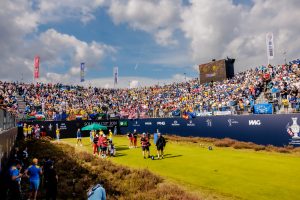
The 20th Solheim Cup, one of the most prestigious events in global golf, took place at Bernardus Golf in the Netherlands from 10–13 September. A premier international team competition in its own right, the Solheim Cup is fiercely contested biannually between Europe and the USA, with teams of 12 players going head to head over three passionate days of competition. It follows the same format as the Ryder Cup, with 28 matches – eight foursome and eight fourballs over two days and 12 singles on the final day. Its growing global audience reflects the rising profile and popularity of women’s sport. This meant that our dedicated golf team working for European Tour Productions pulled out all the stops to ensure that millions of viewers worldwide could follow the action as Europe regained the trophy.
For Gravity Media, the Solheim Cup represents much more than three days of world-class golf; it’s a huge team effort. With the Walker Cup also taking place from 5th-6th September on its biennial rotation this year, the Gravity Media team provides facilities on five events across three weeks: the Omega European Masters in Switzerland, the Walker Cup in Ireland, the Solheim Cup and the Irish Open, finishing off with the BMW PGA Championship at Wentworth.
This requires a huge mobilisation of people, facilities, vehicles and specialist equipment across multiple European locations. That sheer scale, combined with the complexity of moving from one major event to the next, is something the Gravity Media team has become exceptionally experienced at managing, as facilities provider for the DP World Tour.
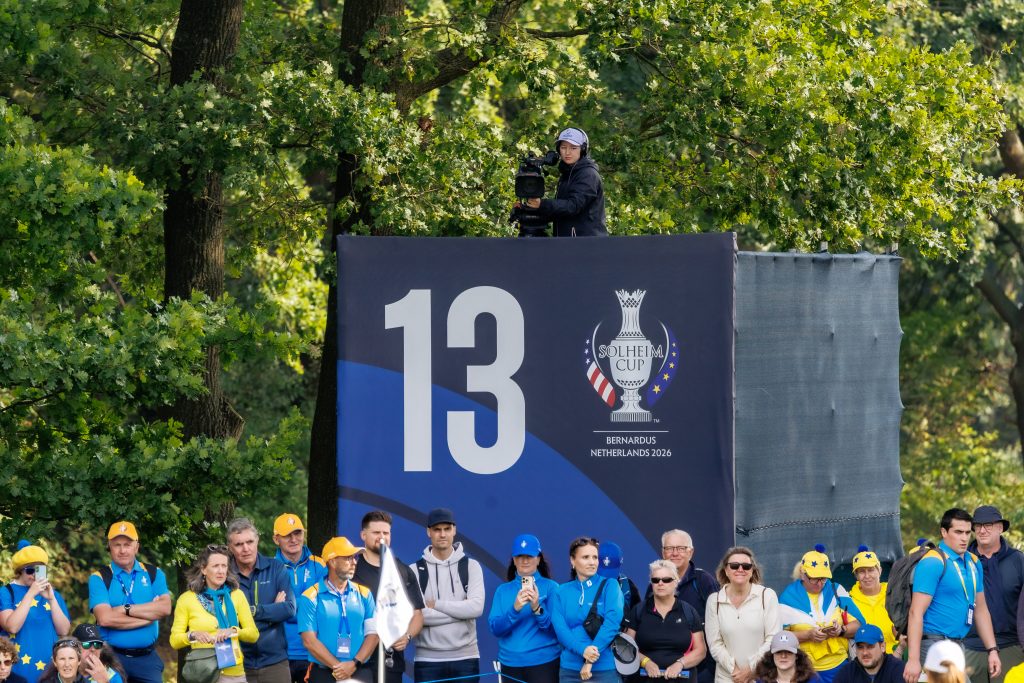
We’ve covered many Solheim Cups over the years, and its position in the golfing calendar always makes it a significant operational undertaking. It requires not only having the right people and equipment in the right place, but moving them, often directly from one event to another, while maintaining the same high standards of delivery across every production. Months of planning, detailed logistics and constant communication are needed to ensure hundreds of people and millions of pounds worth of equipment is in the right place, at the right time.
With one team required across two weekends in Ireland, seven HGV trucks needed to double-drive to the Netherlands from Switzerland. Crew had to be brought in and out along the route to stay within strict European driving-hour limits; the logistics alone demanded meticulous planning and coordination. Behind the scenes, the Gravity Media golf team was effectively managing a continuous operation spanning thousands of miles, multiple countries and five major events. With little margin for error, care had to be taken to keep everyone informed of any changes to ensure plans stayed on track.
Moving to IP
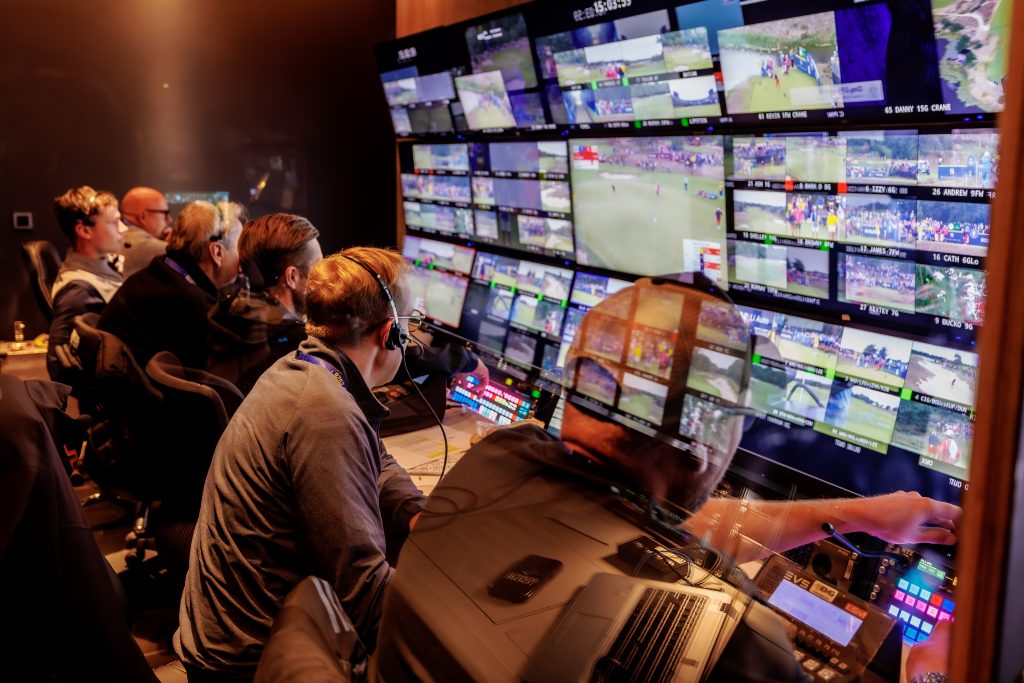
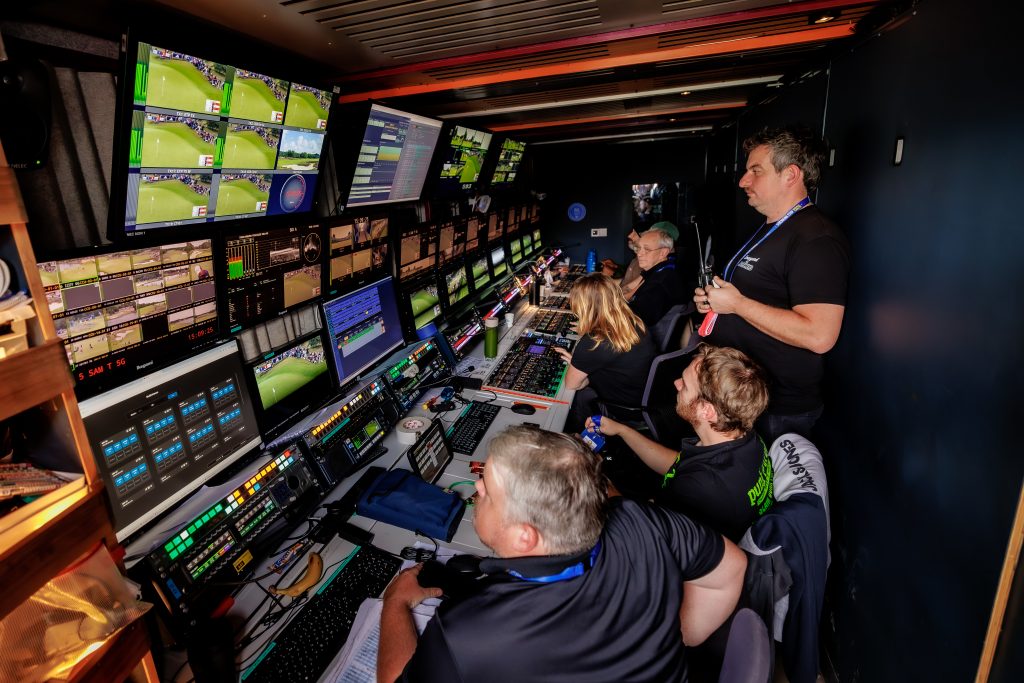
Our world feed production for European Tour Productions (ETP) ran this year from the newly updated IP truck, NOVA 112, marking the first time we have supplied a full IP workflow for the Solheim Cup. Effectively three separate vehicles, the NOVA 112A UHD is a triple-sleeve expanding scanner providing 42 operational positions. NOVA 112B provides another 20 positions, and a third tender vehicle is operated as a mobile data centre into which everything connects. All were operated from a TV compound powered by hydrogen.
With everything running on fibre, there was much less copper cable on site, which helped minimise rig and de-rig times and to keep the compound much tidier. Nevertheless, the scale of the operation remains a significant undertaking requiring a detailed process.
Gravity Media’s crew consisted of over 120 people on site with more than 50 technical crew and a 45 strong camera crew. A team of 25 riggers ensured trucks were where they should be before laying over 20 km of 24-core fibre, feeding SMPTE to-fibre converter hubs, plus approximately 17 km of SMPTE cable from those hubs out to individual camera and mic positions around the course. That means nearly 40 km of fibre and SMPTE cabling was deployed across the venue, alongside the trucks, tender, cameras, RF infrastructure, comms and other facilities needed to support the production.
All in all, cable rigging and de-rigging was carried out within a 17-day window, highlighting the logistical challenges that come with multiple events taking place across consecutive weekends. Our on-site delivery lead, Ben Woodgate, drew the first compound plan for the event while working at the Czech Masters two years ago, and it evolved many times after that. This year’s site also hosted Sky UK, BBC, Sky Germany, Ziggo Netherlands, and Canal+ France, alongside a dedicated Solheim documentary team.
Cameras on course
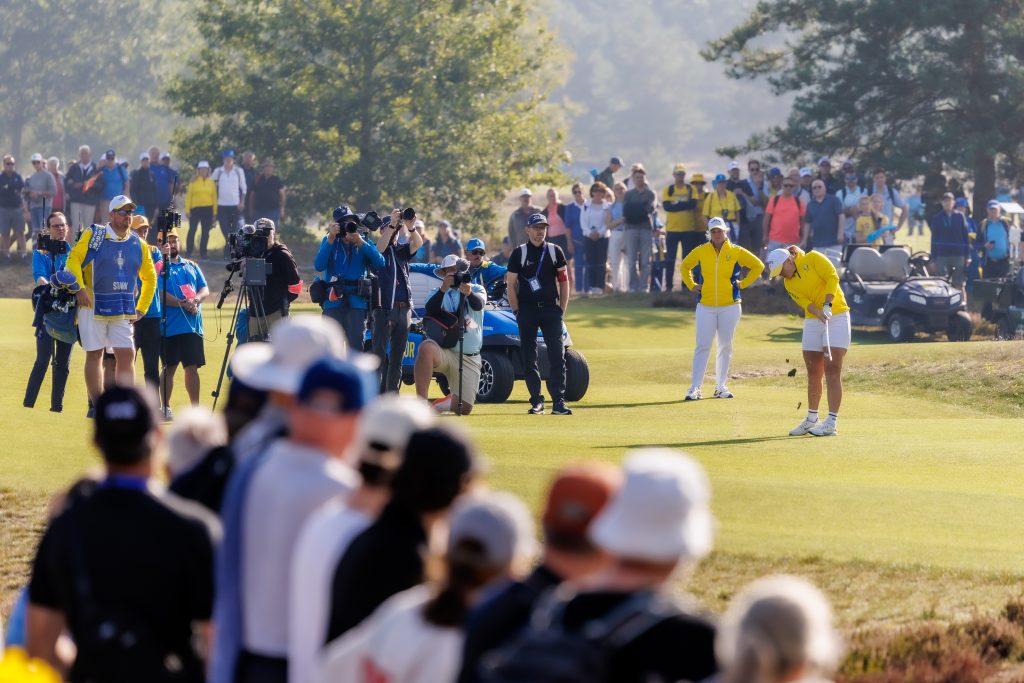
On site, Gravity Media had 25 cabled line cameras in operation, including two TrackMan units positioned behind the tee to draw the ball-trace graphic. These covered 56 different camera positions, including 9 on the opening hole alone. Unlike at the Open, where dedicated positions are fixed for the week, cameras commute between multiple locations. Most covered an average three positions each, while the two TrackMan cameras commuted between four apiece, covering eight positions between them.
A slow-motion X-Mo, Steadicam, and aerial coverage via a UAV rounded out the camera profile. The RF infrastructure for the Solheim Cup ran through only three receive and transmit crane hoists on site, a comparatively light footprint made possible by the flat Dutch terrain. The BMW PGA Championship at Wentworth starting September 17, by contrast, needs twelve dedicated RF sites given its hillier, wooded layout.
One of the vital background tasks that needed to be locked down prior to the tournament was coordinating frequencies with the Dutch authorities. This was genuinely challenging, as there were narrow bandwidth allocations to work within, and we were handling the frequency applications for every broadcaster on site, not just our own operation.
The scope of what we supply to other broadcasters at large events such as this varies enormously and covers a whole spectrum from a clean feed and a monitor at one end of the scale to a full comms set-up at the other.
First-tee presentation was covered separately, with the Gravity Media specialist camera division supplying two minicams and two lipstick cameras for the announcer position. This year for the first time we were also covering the Opening Ceremony on Thursday night with a seven-camera shoot.
Experience at scale
The Solheim Cup is a great example of the combination of experience, expertise and sheer international scale that sits behind one of Gravity Media’s deliveries. While our golf crew was moving between Switzerland, Ireland, the Netherlands and the UK, other Gravity Media UK teams were simultaneously delivering major football, rugby and tennis events in the UK, Europe and the US. The ability to manage this volume of work concurrently is a reflection of both the depth of our specialist teams and the scale of the resources Gravity Media brings together.
Each production demands the same attention to detail and excellence as the one before it and the one after it. The Solheim Cup is the kind of operation where the audience should never see the complexity behind the scenes; everything simply needs to be in the right place at the right time and be working exactly as it should. That takes experience, detailed planning, and the right team.
It’s this combination that enables Gravity Media to deliver at such scale, ensuring that even the most complex production runs seamlessly so that audiences around the world can focus on the sport and the moments that matter.
